Career Transitions: Changing Chapters is Normal. So Where's the Stigma Coming From?
(And what does fried chicken have to do with it?)
Freshly Reframed: Coaching-inspired reflections and prompts by Freshly’s in-house coach Izzy Abidi based on 100+ hours of real sessions. Combining professional coaching, rooted in the science and design of positive psychology, blended with the art of storytelling to support individuals through their story arcs across transitions, confidence, career and leadership.
Changing careers gets treated like a crisis. A pivot. A reinvention. A problem to solve.
How are other changes in our lives treated? People change homes, relationships, cities, religions, minds, bodies, entire continents. We move through life expecting evolution. We celebrate it, even.
So why is changing careers still treated like you’ve failed at something?
The Stigma Isn’t About You
Before we dig in, let’s agree on something: change is normal.
People change homes. People change relationships. People change cities. So why is changing careers still treated like a crisis?
The stigma is not, and never was, about you. The stigma comes from the stories we tell ourselves using the systems we are in (for example, a work organisation chart) as a point of reference.
We’re taught to see work as a straight line. Graduate, climb, peak, retire. Job titles are hierarchies. Salary is status. And if you step off that line (or worse, backwards) something must be wrong. With the job. With the market. With you.
Reminder: real life zigzags. Always has. Always will.
But the systems that frame our careers? They’re still built for the straight line. And that creates a particular kind of shame around the idea of moving on and this is exactly where a belief of “backwards” can come from.
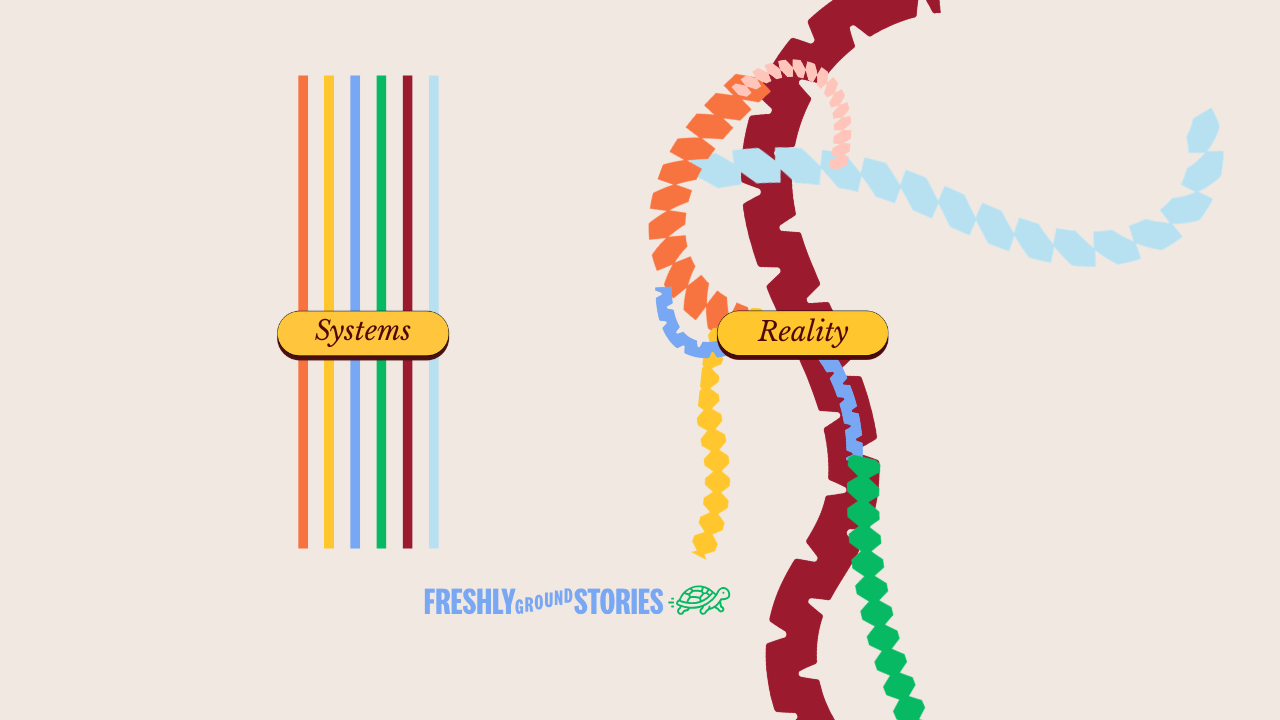
A beautified sketch from a real-life coaching session on career transitions, by Izzy Abidi
What the Messy Middle Actually Looks Like
Career transitions don’t announce themselves. They don’t come with press releases or LinkedIn posts (well, they can, but that’s not where they start).
Most of the time, they start quietly. With a feeling.
You reach a point where you can’t keep building something you no longer believe in. Maybe it was the right thing five years ago. Maybe it paid well. Maybe people were impressed. Maybe you were impressed. But somewhere along the way, the alignment broke. And now you’re showing up to work as a version of yourself you’ve outgrown.
Reminder: all the work you’ve done so far isn’t wasted. It’s often the foundation for what comes next.
Or maybe it’s different. Maybe you got good at performing success - the money came, the recognition came - but somewhere in the middle of that achievement, you realized it wasn’t your success. It was the success you were supposed to want. And now the gap between what looks good on paper and what actually feeds your brain, or your heart, or both is too wide to ignore.
Or maybe you’re in the thinking-about-it phase. The one where you don’t know how to answer “what do you do?” anymore. Every time someone asks, you freeze. Because the old answer doesn’t fit, but you don’t have a new one yet. So you mumble something about “exploring” or “in transition” and watch their face try to process that you’re not quite anything (again, their frame of reference, not yours), anymore.
This is the messy middle. It looks like:
Feeling lost between phases
Quietly rebuilding while still in the old job
Rekindling curiosity in unexpected places
Not knowing how to introduce yourself
It’s not glamorous. It’s not linear. But it’s where most real transitions actually happen and where the magic of being human comes out to play. The messy middle is such a pivotal arc in the stories we tell about a chapter of triumph in our lives and most of us don’t realise that when we’re in it.
The Real Problem Isn’t Ambition
Here’s what we don’t talk about enough: sometimes the resistance doesn’t come from you. It comes from everyone around you.
When everyone in your day-to-day life is doing more of the same, change can feel like betrayal. Like you’re saying their choice isn’t good enough which, of course, you’re not. But that’s how it lands.
And when you’re already uncertain, when you’re already in that thinking-about-it phase, other people’s certainty can feel like gravity. Other people’s opinions, or assumed opinions, keep you anchored to something that no longer fits, simply because pulling away would require explaining yourself.
Reminder: just because something works on paper doesn’t mean you have to keep doing it.
That’s different from actually being afraid to change. It’s the weight of other people’s expectations layered on top of your own doubt. And it’s powerful enough to keep people stuck for years.
Just when you think you’ve finally figured out that you want to change, another thought comes up: loneliness. So, let’s address it.
We All Crave Belonging
It’s so easy to confuse fitting in with playing it safe. Often, people stay where they no longer grow (intellectually, spiritually, emotionally) because it feels like the safer option. They feel like they are part of a bigger sense of purpose, surrounded by lots of people who know their name and they are constantly called a team member. Until one day, it suddenly stops feeling so cosy. That safety, for some, can very quickly feel like you’re stuck and can have a knock-on effect on many other facets of our life outside of our career.
Ever noticed how a stressful situation at work can affect how you show up for your loved ones? Yes, that.
Reminder: systems don’t provide safety, community does.
It’s Never Too Late: The Colonel Sanders Moment
Harland David Sanders was a streetcar conductor. A farmhand. A soldier. A streetcar conductor again. He tried a lot of things before fried chicken.
At 62, he franchised KFC. There wasn’t one dramatic moment where he suddenly figured out his life purpose, nor did he reinvent himself or have a five-year plan. He just gave himself time and followed the thread he was curious about.
You might be reading this and think “OK, I don’t have a lot in common with the identities Colonel Sanders carries”. Let’s throw in some more examples for good measure:
Reframe: “I’m too old” → “I have the maturity to know I need to try”
Tope Awotona
Tech sales → Founded Calendly at 32
(worth reading his story)
Ava DuVernay
PR → Began Directing in her 30s
Alan Rickman
Graphic designer → Began acting at 41
Colonel Sanders
Firefighter → Started KFC at 62
Vera Wang
Magazine editor → Became fashion designer at 40
Reminder: it’s never too late to pivot. And you don’t need a grand narrative to justify it.
Where Do You Go From Here?
Career transitions can look messy because they are messy. But here’s what makes them navigable:
Give yourself time. Not the kind of time where you’re waiting for burnout, or a breakdown, or one pivotal moment to make the decision for you. The kind where you’re actively, quietly paying attention to what doesn’t fit anymore. What makes you feel alive. What you’d do even if no one was watching.
Get clear on whose opinions you’re listening to. Are you resisting change because you genuinely want to stay? Or because everyone around you seems comfortable with the status quo? These are different questions, and they need different answers.
Practice the awkward self-introductions. New stories often start with awkward self-introductions. “I’m exploring what’s next” or “I’m between chapters” or “I’m not quite sure yet” - these aren’t failures. You’re simply practising your next chapter. And every time you say it out loud, it becomes a little more real.
Remember: your story is unfolding into the next chapter. There is no such thing as “going backwards” in this context.
A Reflection for Where You Are
Sit with one of these for a moment:
If you’re in the thinking-about-it phase: What would you do if no one was watching? What would you do if you didn’t have to explain it to anyone?
If you’re quietly rebuilding: What are you rekindling curiosity about? What thread keeps pulling at your attention, even when you’re not thinking about it?
If you’re in the messy middle: What would it feel like to pause the shame and just follow the thread?
You don’t need to have the answer yet (or post about it on social media). You simply need to be honest about the question with yourself and that’s a really powerful start.
If you’re in this space-between, we’d love to hear how it’s showing up for you. What’s your version of the quiet shift?
This article is dedicated to the ones in transition - the people quietly rebuilding their careers from the inside. High-five. Keep going.
💌 Know someone quietly navigating a career transition? Feel free to pass this their way.
Small reframes can shift everything - the art is noticing them Try one of these prompts with a friend or teammate and see what comes up.
More coaching tools and reflections via our social pages or book a free conversation through our Coaching page.
Or, speak to Izzy directly.