
Alchemical Alignment: Sahar Milani
On building a career that feels human, the art of surrender and why “no” is a song
Chapters in-between: At any given time, we are all a draft-in-progress. Conversations with people navigating the in-between chapters: the pivots, the pull of creativity, the challenges of leadership and the unfinished arcs that shape us most.
We ask the deep questions and give time to answer, because great stories take time. This series is the long read many of us are craving.
Sahar Milani has a way of speaking that slows the room down while deepening its energy. In a world that keeps asking founders to perform certainty, she keeps coming back to something gentler and braver: meaning over metrics, love over fear, and the kind of leadership that makes space for being, not just doing.
Milani is the founder of Sorshaa (@sorshaa.edits), a brand and storytelling advisory shaped by two decades across industries and continents. She is also the host of Mindful Makers, a podcast built as “an ode to that entrepreneurial spirit but with a very intentional lens of mindfulness applied.”
In this Fieldnotes conversation, she talks about growing up with constant pivots, moving away from law, learning to say no (properly), and the transitions that don’t just disrupt you but invite you.
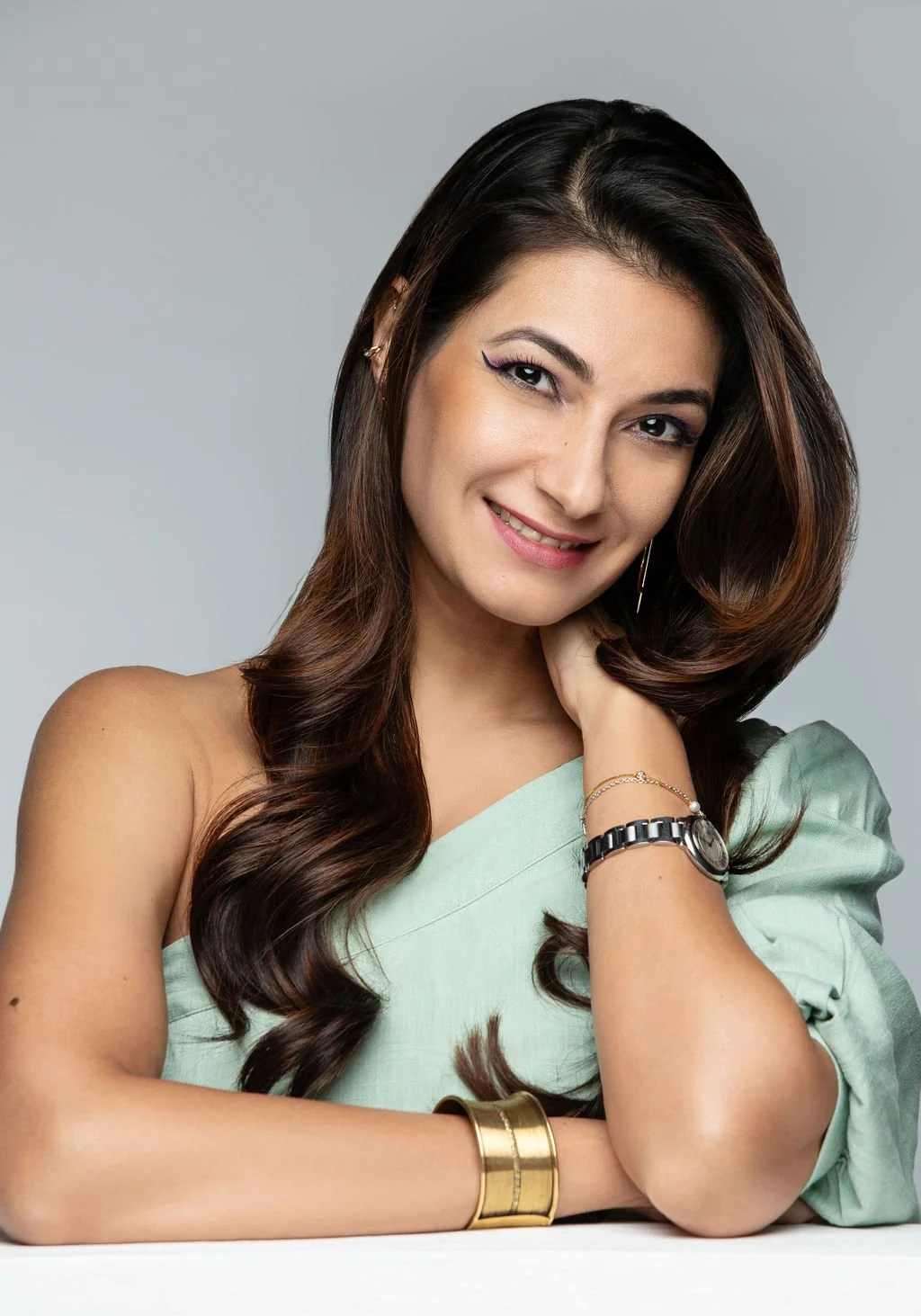
Sahar Milani. Image courtesy of Sahar Milani.
If you were speaking to your younger self, how would you describe who you are today in both work and spirit?
I would tell her that your spirit is very much the same. It is such a deep part of you that ebbs and flows with life, but has this great ability to help you return to yourself through all the seasons that you go through. And I would tell her that your spirit is strong and gentle at the same time and keep doing things to look after it.
In terms of career, I think I would just let her be surprised. I don’t think I would describe it to her in any way, but I would tell her that the things you do are always in pursuit of love. And I think she’d enjoy that more than a clear definition.
Is that what drives you today, that pursuit of love?
Oh, 100 percent. Reflecting as well on things that have driven me throughout my life, it’s always been a move either away from something that I no longer felt in love with, or a move towards it. Be it continents, be it relationships, be it work, be it anything. Love has been this common thread.
And it’s also been something that’s always driven me to reflect and take a moment to just center myself and to question: is this where my heart’s at? And how can I help it get there, if not?
You often talk about the power of curiosity. When did you start recognising it as a driving force?
The label of ‘curiosity’ per se has emerged in the last three years, but only as a result of reflecting on the fact that I’ve always been a curious person. Since childhood, I’ve been exploring, discovering and finding out new things about the world around me. It’s also this deep passion of mine that loves detail and loves knowing the hows and the whys.
Curiosity, whether at work or play, has been a very big driver. It creates space to experiment, to connect on deeper levels, and to embrace everything that comes with that, the tries and the failures, and even the discomfort at times. It has always been there but I’ve never really given it a spotlight until recently.
What sparked that reflection in the last few years?
The reflection really came from a deep space of pause. Certain life events came my way that caused me to just really want to take a breather and decide to just stop for a bit. I don’t know if you’ve heard of this book called Wintering by Katherine May: this aspect of stillness within and going within.
So following a good few seasons of wintering, I was able to allow myself the space to communicate that. Before, my life was very in flow and very fast-paced. It still is in some ways. But I allow myself moments of stillness that allow that opportunity to just call something out that I wouldn’t have necessarily noticed if I was so busy. So that’s really where it came from, the ability to be still..
What helped you move through discomfort and fear during big transitions?
Surrender did. These are pivotal moments or transitions. They’re key moments in our lives where we either face them or we don’t, but they change us in some way or the other. And there’s always this liminal space before the transition and after the transition.
Previously, I’d assumed that each time I’d navigated a major change, like moving to a different country or starting a new job, I thought: been there, done that, got the t-shirt. But life showed me transitions will never be exactly the same. And that is because we never are.
We’re in constant flow and evolution as beings and therefore the transition meets you where you are at that point. That held a really unique lesson for me because it allowed a space of surrender.
And I bring that into my work now. This deep knowing that brands, stories, people, lives, they do not move in a linear way. They evolve in layers and they shift with context. So you need to meet them where they are and support them in different forms and different types.
Sorshaa means “light” and “brightness.” What light were you trying to shine when you started it, and has that evolved?
When Sorshaa began, it was my tribute to the world of branding and marketing, but from an angle that honored alignment and clarity, marrying that with creative storytelling.
Helping people return to their own values brings out the light and it helps build a strong message. In storytelling, when you work on articulating the truth, not just something that you think people want to hear, but actually bringing in a conversation that drops the armor and brings out intimacy is far better.
It really helped me meet this desire I have of marrying creativity with strategy and that intersection that creates a unique experience. I know these can be buzzwords in marketing, and that’s really not what I’m about because it’s bringing in the grounding that has come through 20 years of experience. It’s not something that happens overnight.
Connection is the heart of work and I truly do believe that. The pain point before that was witnessing how fickle some marketing campaigns can be, when people are chasing the numbers and chasing the version of success that they’re taught to believe is the metric and not actually looking at the meaning. I will always follow the meaning. I prefer meaning over metric any day.
Did you ever feel pressure to conform to commercial needs that didn’t align with your ethos?
At the end of the day, people want to earn an income. They want to make a living and I’m not afraid of embracing commercial needs whatsoever. It’s vital to the energy of a business.
What I invite clients to do is allow time to bring out results that will be more sustainable in the long run rather than short and sharp sensational things that satisfy eagerness for commercial success in the moment but forsake something that could build long-term success in the future.
If clients are only interested in immediate returns and aren’t really thinking about the longevity of their business, that’s a different conversation. And I’m okay to accept that perhaps that’s not me.
So you’d move on from a client if you’re speaking different languages?
I am very good at compromise and understanding and trying to help as much as I can. But if we’re speaking different languages, then there needs to be freedom on both sides to decide.
I would like to believe that the clients that I do work with understand how to redefine success through meaning and not metrics, and they choose alignment over approval. It comes back to moving from love and not fear.
What does emotionally intelligent leadership mean to you?
Having gone through a deep and expansive self-development journey myself, I’ve experimented and used myself as a guinea pig when it comes to modalities and tools that help nourish my entrepreneurial approach but also create space for connection and conversation.
No one size is going to fit everybody. Emotional intelligence will meet you where you are in that moment with the tools that you already have. The importance is to constantly have a lens of curiosity about it so that you’re able to encourage conversations that create more understanding, safety, connection, and compassion.
Compassion can get lost quickly in leadership because a lot of people have an outdated model of what it means to be a leader today. Things can dramatically shift when you bring in understanding and compassion through conversation.
What have you learned from your podcast guests about intention and leadership?
There are many avenues to showing up with intention and creating something of meaning in the world. There is no one single formulaic route to being more mindful, being more present and doing better.
We don’t have to match society’s pace. You don’t have to honor a rhythm that is not in sync with your essence because it was written in a book somewhere by a scholar. The honoring of rhythm and uncertainty has been such a wonderful gift I’ve learned from my guests.
Their ability to step into the unknown and uncertainty and go through a metamorphosis as a result, or sometimes just come out the other end and say, ‘That was really rough, and this is how I show up having lived through that’.
It’s about learning the art of surrender. That can be difficult if all we’ve been taught is to perfect or please or strive or achieve. But when it’s done with intention, you can see green shoots grow through trust and timing, things beyond your control.
Was there a specific pivot that shaped you?
I see my life as a kaleidoscope of pivots ever since I was a child. I’ve moved countries, worked across continents, built relationships and friendships in different time zones and lost them as a result of time zones.
Personally, having moved countries four or five times between the ages of 8 and 18 was quite a lot of pivoting. Those were not chosen moments, but they did build this desire for deep connection with the world around me and the people I surround myself with.
Professionally, making the decision to move away from law and pivot towards branding, storytelling, exploring how my own spirituality, and my curiosity for the human experience was quite a big step. It was an admission that perhaps the life I planned for myself was not necessarily going to be as structured as I believed when I was at school.
I knew there was a part of me that was so creative and there’s also still a part of me that’s so logical and rational and strategic. I wanted to marry them. I wanted them to feel whole.
You wear a lot of hats. How do you balance them without burning out?
There is this impression that the life of an entrepreneur is one of owning your time and freedom. That’s a belief I subscribed to when I was in the corporate world.
In the beginning, I tried to do it all at the same time and thought that was the only way. What I learned very quickly is that burnout is not exclusive to full-time employment. Burnout can meet you in multiple spaces in life because you leave the door open for it.
So I started shutting some doors and with that came the sacrifice of perhaps taking on less, but things became much more intentional.
A very real example: I have just qualified as a Colour PsychoDynamics practitioner. There could have been a choice to continue recording season 4 of the podcast. But I decided not to repeat that cycle, to pause and allow myself to give this part of my life the startup energy it needs and deserves.
I see my creations as living creatures. They’re parts of my soul and my essence. It’s important to honor that and protect my energy - what feeds my soul? Because then I can come back even stronger.
How did you learn to shut doors?
Learning to say the word ‘no’ was quite vital. Self-confessed historical people pleaser here…so the word ‘no’ was taboo in my dictionary before. But I’ve become very comfortable with it now.
No is a complete sentence?
No is a song. It’s got backup dancers!
What role has support played in your journey?
Support is a huge factor when it comes to anything you want to do in life. Growing up raised by a single parent, being quite independent as a child, I learned to rely on myself. But then I realized that comes at a cost and it’s unrealistic in the long term.
The bigger things in life require a really good support network and being able to ask for help. Asking for help suddenly became the biggest shield and sword for me. It made me realise you can expand and do more when you’re in that space.
My support network, or as I like to call them, my board of advisers, hasn’t simply been a network. They’ve been pillars. One of them being my Mum. When I was thinking of quitting my previous role and I wasn’t sure, she said, “What are you afraid of? What do you have to lose? And what do you lose by staying?”
In that moment, I felt that I have myself to lose, I have passion to lose, and I have meaning to lose. Those were my non-negotiables.
And my husband, he is a great listener. Listeners are powerful mirrors because sometimes that’s all you need. You frequently know the answer, but by articulating it, you arrive where you’re supposed to arrive. You just need somebody to witness and hold space for you.
How do you communicate what you need from your “board of advisers”?
They’re human beings with their own set of ups and downs. So I make sure I’m clear and intentional when I show up asking for advice or wanting to feel heard.
Start the discussion clearly: ‘I’m sharing this with the intention that I need your opinion’, or ‘I just need to be witnessed’. It allows the other person to put the right hat on. It also allows them to say, ‘I have the capacity to deal with this now’, or ‘can I park it and come back to you’.
It’s important to bear witness to the person in front of you. They might need to be witnessed too - reciprocity is important.
For someone at a crossroads, what should they ask themselves before taking a leap?
First and foremost, I would ask them to notice what ‘season’ they feel they are in, because we all have these seasons. Different parts of our lives will be in summer, other parts in winter, and some stuck in autumn. Looking at it seasonally removes comparison and brings you back to individuation.
Second, look at where you’re placing your trust. Trust is huge and it’s fragile. If you don’t have trust, it’s easy to get caught up in narratives that don’t belong to you.
Also, look at what is meaningful to you rather than a generic metric. Some people seek certainty in numbers and that’s fine. But owning it is important. And if it doesn’t give you meaning, admit that and redefine success on your terms.
And please build careers that feel human. Build something that feels alive. We only get one life. This is not a dress rehearsal. Make it human. Bring awareness, courage, heart. It’s an invitation.
With AI rising, what are you most excited to explore in the next five years?
First of all, I love AI. It’s fascinating and it’s a really interesting time to be alive. But like every new tool, what I’d like to see is emotional intelligence and human intelligence be elevated to meet change in a way that is serving.
I want to see more connection, more togetherness, less division. There’s way too much division in the world right now and it’s unnecessary.
What season are you in right now? And what’s the chapter title?
If it was going to be the broad one that’s overarching, I would say spring. But there’s also a part of me that’s really looking forward to wintering. So I’m holding that lightly.
And the chapter title?
Alchemical alignment.
How did this conversation feel for you?
Fresh. Really fresh. Because it took me on a journey that people rarely ask me about. We can be very much wedded to a space of doing and I’m very much about being. And while that’s not the traditional definition of entrepreneurialism, I think it’s time to redefine it.
Fieldnotes
If there’s a throughline to Sahar Milani’s story, it’s this: treat every pivot as an invitation, not a disruption. Learn the art of surrender without turning it into passivity. Choose meaning over metric, alignment over approval, and build work that feels alive. Protect your energy like it’s part of the job, because it is. Tell your support network what hat you need them to wear, then let yourself be witnessed. And if the world asks you to chase the quick win, remember that longevity is built in seasons, not sprints.